Course Introduction
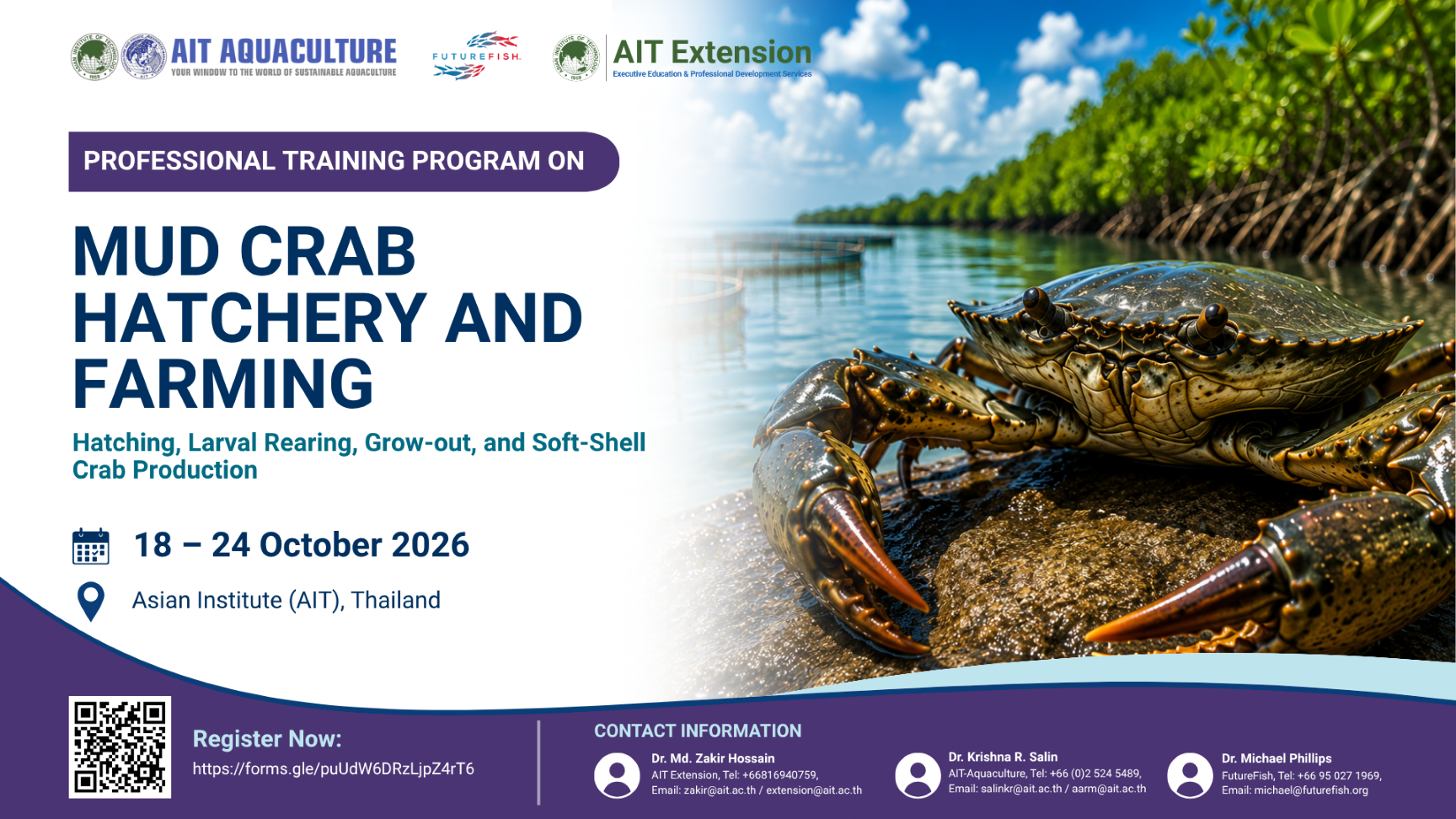
This course introduces participants to integrated mud crab hatchery and farming systems, covering the complete production cycle from broodstock management and natural hatchery operations to larval rearing, grow-out, fattening, and soft-shell crab production. Through a combination of expert-led lectures, hands-on practical training, laboratory and pond sessions, and technical visits to commercial mud crab farms in Thailand, participants will gain practical knowledge and industry-relevant skills to improve production efficiency, strengthen biosecurity, and promote sustainable mud crab aquaculture.
This program covers:
1. Mud crab species identification, biology, moulting, reproduction, and life cycle
2. The mangrove ecosystem's role in crab productivity; site selection for pond-based hatcheries
3. Pond design, preparation, and management for mangrove-based natural hatchery systems
4. Broodstock selection, transport, conditioning, and management of berried females for spawning
5. Natural larval production: stage identification, live-feed culture (microalgae, rotifers, Artemia), and feeding schedules
6. Water quality management (salinity, temperature, DO, pH, ammonia, alkalinity)
7. Nursery rearing: stocking density, shelter/substrate management, feeding, grading, and cannibalism reduction
8. Grow-out, fattening, and soft-shell crab production — stocking, feeding, moult induction, and harvest timing
9. Disease management, biosecurity, predator control, and post-harvest handling
10. Farm economics, marketing channels, and Group Action Plan (GAP) development
Key Learning Outcomes:
1. Identify mud crab species and describe their biology, life cycle, and habitat requirements.
2. Design, prepare, and manage mangrove-based ponds for natural hatchery and larval rearing.
3. Select, condition, and manage broodstock; oversee spawning, egg incubation, and larval development.
4. Apply nursery rearing techniques for crablets, including live-feed, water quality, and grading.
5. Operate grow-out, fattening, and soft-shell crab production in pond and tank systems.
6. Manage feed programmes, disease risks, biosecurity, harvesting, and post-harvest handling.
7. Evaluate farm economics and develop practical action plans for implementation.
For information on the training fee and other related expenses, please register or contact us:
Dr. Md. Zakir Hossain, AIT Extension, Tel: +66816940759, Email: zakir@ait.ac.th / extension@ait.ac.th
Dr. Krishna R. Salin, AIT-Aquaculture, Tel: +66 (0)2 524 5489, Email: salinkr@ait.ac.th / aarm@ait.ac.th
Dr. Michael Phillips, FutureFish, Tel: +66 95 027 1969, Email: michael@futurefish.org